Following my continuing fascination with online mapping, a friend pointed me towards AsciiMaps.com – it has to be seen to be believed!
Thanks Con!
Following my continuing fascination with online mapping, a friend pointed me towards AsciiMaps.com – it has to be seen to be believed!
Thanks Con!
Here’s an interesting article about Interactive fiction, i.e. the old-style text-based adventure games popular in the 80’s and 90’s. If you remember playing any Infocom titles, you’ll find this a good read.
In my continuing search for ways to improve traffic flow (rather ironic, since I’m working from home these days), I came across this analysis of how small variations in departure time for the morning commute could lead to significant time savings.
Friends who commute from North Wicklow to Dublin city centre had told me that there was a narrow window in the morning when you could get a clean run into the city without too much delay – about 10 minutes after the early morning rush has subsided but before the school runs kick in. This article appears to support that theory (albeit on a different continent!)
(Of course, there are the usual Slashdot comments on the article also…)
Maybe one day, I’ll actually get to put all this theory to use…
Steve pointed me towards an interesting demo video showing off the capabilities of the HAL 2000 home automation system. It lets you control your home using speech commands from any room – quite impressive.
The author has an extensive discussion of the technology involved (speakers, distribution amps, microphones, etc.) along with some comments on the limitations of the system.
Startrek’s onboard computer suddenly doesn’t seem quite so far away…
(If that title doesn’t quicken your pulse, nothing will…!)
Following on from my mention last November of the guy who was experimenting with shaping traffic flow by varying the speed of his car on slow moving highways, Michael pointed me towards this interactive traffic simulator.
I don’t know if it’s accurate, but it’s good fun to play with…
I use Winamp as my default MP3 player for Internet Explorer. Every now and again, Apple’s Quicktime player seems to hijack the file association, so that when I download MP3 files off the web, they play using the Quicktime embedded media player (which I dislike).
None of the obvious ways of undoing this hijacking seemed to work. Today, however, I came across a method that does work:
Simple when you know how…
Having recently bought an XBox 360 to use as a Media Centre Extender with my main MCE living room PC, I was dismayed to find that my network drives were not accessible when using the extender.
A bit of research showed that this is a consequence of how the MCE Extenders connect using the Remote Desktop capability of Windows XP – mapped drive letters are only accessible under the username they are created under, and the extender has its own separate user account (usually MCX1).
Unfortunately, the password for that account is not available. However, there is a simple workaround. The original description came from Chris Lotter’s Blog, but I’ve reproduced the important details here for easy reference.
To make mapped drives visible under Windows Media Centre Extender, you need to follow these steps:
@echo off
echo Mounting remote network drives...
net use m: \\192.168.100.20\MP3     /user:world\eddy.carroll mypassword
net use p: \\192.168.100.20\PHOTOS  /user:world\eddy.carroll mypassword
net use v: \\192.168.100.20\DVD     /user:world\eddy.carroll mypassword
Replace ‘world’ with your workgroup name, ‘eddy.carroll’ with your server account name, and ‘mypassword’ with your server account password.
You’re now done. Simply disconnect and reconnect your Extender, and it should now be able to see all the media on your mapped drives.
Thanks to Conor for this interesting interview with Bill Yeager, the author of the first network router.
(Surprise, surprise … Cisco didn’t write it all themselves.)
Longtime readers (assuming there are any!) may recall a story last May about a new type of flatpanel CRT using nanotubes. The demo back then was impressive from a technology viewpoint, if not something you might actually want to sit down and watch.
Well, time has marched on and these products are almost ready for market. They are now known as Surface-conduction Electron-emitter Displays; somehow, I think SEDs will turn out to be the more popular term.
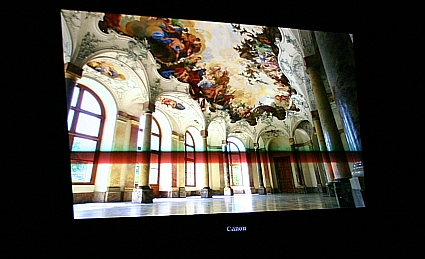
At CES, Toshiba unveiled some 37″ HDTV prototypes with a contrast ratio of 100,000:1 (yes, that’s quite good!). They hope to have 55″ production models towards the end of the year. Response time is on the order of 1 ms. Another description can be found here.
And here’s a particularly enthusiastic first-hand review from one of the CES attendees, complete with photo:
Roll on Autumn…
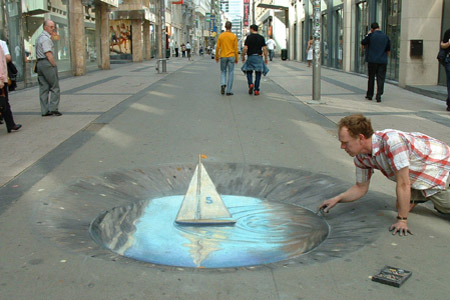
Not everything needs to be about bits and bytes. I recently came across a guy called Julian Beever who does absolutely incredible pavement drawings. Here’s a sample (used without permission … sorry):
You can see some more examples of his work here…